
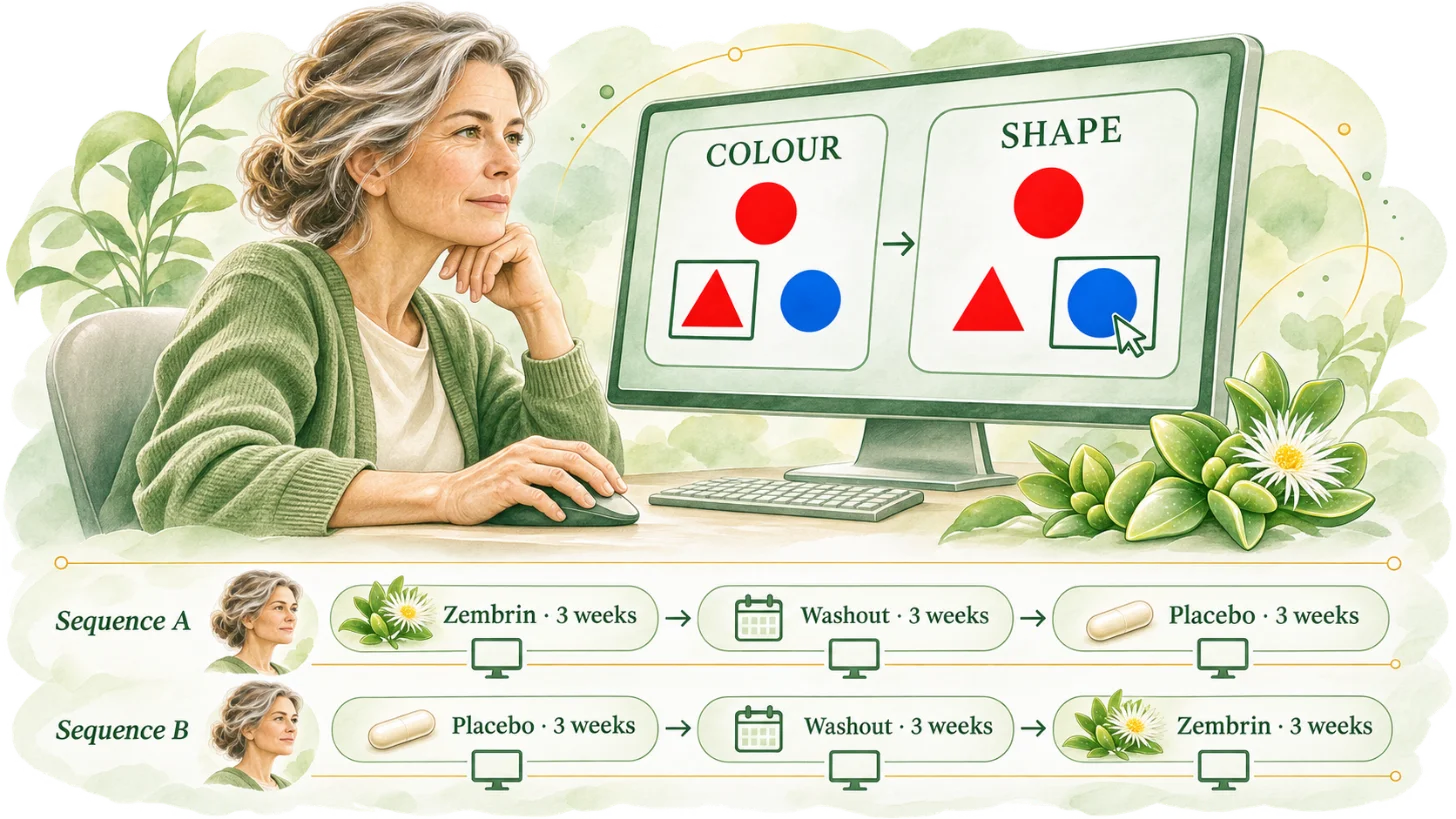
In short: A small 2014 trial reported better cognitive flexibility and executive function scores after three weeks of Zembrin, a specific kanna extract, than after placebo. The findings concerned selected computerised test results in cognitively healthy middle-aged adults; the overall cognitive index and memory results did not show a clear benefit. Inconsistencies in the paper's numerical reporting also limit how confidently the size of the benefit can be described. [1]
A familiar road is closed. You know where you want to go, but the route you usually take is suddenly useless. Finding another way requires a small mental adjustment: keep the destination, change the plan.
That is an everyday illustration of cognitive flexibility — adapting when the rules or circumstances change. It sits within the broader family of executive functions, which help us organise a response, hold a goal in mind and resist an unhelpful automatic action. [1, Discussion]
Could a botanical extract influence these abilities? Simon Chiu and colleagues explored that question in a trial of Zembrin, a standardised extract of Sceletium tortuosum, commonly known as kanna. Their results were most encouraging in these two related areas of cognitive control. Looking at how they reached that finding makes its promise, and its limits, easier to understand. [1]
Three weeks with the extract, three weeks with placebo
The study recruited 21 adults in Puerto Rico. Their average age was about 55, and they were considered cognitively healthy. This was a study of people without diagnosed cognitive impairment, rather than patients seeking treatment for dementia. [1, §3.1]
Participants took a capsule containing either 25 mg of Zembrin or placebo each day for three weeks. After a three-week break without either capsule, they switched treatments for another three weeks. The whole study therefore lasted nine weeks, with three weeks of active treatment for each participant following the planned schedule. [1, §2.4]
This is called a crossover design: people experience both conditions, allowing researchers to compare their performance under each. Treatment order was randomised, and participants and researchers were blinded to the capsules being taken. [1, §2]
The extract was defined quite precisely. It had a plant-material-to-extract ratio of 2:1 and was standardised to 0.4% total content of four specified alkaloids — naturally occurring compounds in the plant. The experiment therefore concerns this preparation and dose; it cannot automatically describe every kanna powder, extract or blend. [1, §2.2]
What changed in the tests?
The researchers used CNS Vital Signs, a computerised battery covering several cognitive domains. They measured performance at scheduled visits and compared the baseline results with those after each treatment period. [1, §2.4]
Two related outcomes stood out: executive function and cognitive flexibility. The authors reported that both improved with Zembrin compared with placebo. Here are the published means, alongside their standard errors. [1, Table 1; §3.2]
| Published test measure | Baseline | After three weeks of Zembrin | After three weeks of placebo |
|---|---|---|---|
| Executive function | 36.8 ± 5.4 | 60.8 ± 6.6 | 50.1 ± 7.7 |
| Cognitive flexibility | 35.4 ± 5.3 | 60.2 ± 6.5 | 49.7 ± 7.5 |
Values are mean ± standard error of the mean (SEM), a measure of uncertainty around the estimated mean. Table 1 lists 17 observations after Zembrin and 18 after placebo; it does not give a separate baseline sample size. [1]
For executive function, the published final means differ by 10.7 score units: 60.8 minus 50.1. For cognitive flexibility, the difference is 10.5 units: 60.2 minus 49.7. These are our arithmetic calculations from the reported means, not a new statistical analysis or a reconstruction of individual participants' changes. [1, Table 1]
The pattern is worth noticing. Scores in both areas rose after placebo too, but the reported final scores were higher after the extract. A useful account of the result needs both sides of that comparison.
The paper reports p-values of 0.032 for executive function and 0.022 for cognitive flexibility in its main results table. Those values accompany an analysis covering baseline and both treatment conditions. The authors describe follow-up comparisons supporting an advantage over placebo, but do not provide separate exact p-values or confidence intervals for those comparisons. In other words, the paper does not give a clear uncertainty range for the size of the extract–placebo difference. The abstract also reverses the two p-values; the values here follow Table 1 and the main Results section. [1, §2.5; §3.2]
Why the figures are not “24% better thinking”
There is a numerical trap in the original paper. A column labelled percentage change gives 24.0 for executive function after Zembrin. Yet 60.8 minus 36.8 is simply 24.0 — the difference between the published scores. Cognitive flexibility follows the same pattern: 60.2 minus 35.4 is 24.8. [1, Table 1]
We have therefore retained the original means and described arithmetic differences in score units. Calling them 24% or 24.8% improvements would repeat an unresolved labelling problem. These scores are not established percentages of everyday thinking ability either.
The wider cognitive picture was mixed
The overall neurocognitive index did not show a clear advantage: the reported mean was 43.9 after Zembrin and 47.2 after placebo, with p=0.376 in the table's analysis. The positive finding was selective, rather than an improvement across the whole battery. [1, Table 1]
Memory results offered no clear evidence of benefit. Visual memory scores were numerically lower after both conditions than at the listed baseline, and lower after Zembrin than placebo. The analysis did not establish that the extract worsened memory, but these observations belong in the picture alongside the favourable executive function results. [1, Table 1]
Processing speed provided another, less certain lead: its mean was 77.4 after Zembrin and 54.7 after placebo, against a listed baseline of 56.7. The table reports p=0.085. That numerical difference is a reason for further investigation, rather than a settled finding of faster processing. [1, Table 1]
The study also offers no direct answer about whether participants found work, driving or daily planning easier. Those activities were not measured, and the experiment did not test the prevention or treatment of Alzheimer's disease. The closed-road example explains the idea of flexibility; it was not a task in this experiment.
How much weight can a small pilot carry?
The study was short and the analysed samples were smaller than the original group. The authors report two withdrawals during placebo and three during Zembrin, but the sample sizes vary across their tables without a complete explanation. The cognitive table's 17 and 18 observations should not be read as 21 people completing every assessment. [1, §3.1; Tables 1–3]
There were also many outcomes to inspect. When a study examines several domains, selected positive results need to be considered alongside the full set, including the overall index. The publication describes statistical follow-up tests, but leaves important details of the crossover analysis and the handling of multiple outcomes unclear. [1, §2.5; §3.2]
The trial registration was submitted after the study's recorded completion. The registry lists completion in March 2012 and first submission in January 2013, so it does not establish that the published analysis plan was registered before the results were known. [2]
These limitations leave a specific, useful research question: would a larger, clearly reported trial reproduce the two cognitive control findings?
What about side effects?
The authors described the extract as well tolerated and reported no statistically significant changes in measured blood pressure, pulse, temperature or weight. They also described gastrointestinal discomfort that resolved, without a direct link to the extract being assigned by the clinician. [1, §3.3; Table 3]
However, the adverse-event table complicates that description. It contains entries in the category labelled “severe” during Zembrin exposure, including gastrointestinal discomfort, headache, fatigue and drowsiness. The table states that no life-threatening events occurred. The reporting does not fully reconcile these entries with the reassuring narrative or establish that the extract caused them. It would be inaccurate to summarise this as a trial with no side effects, or only mild ones. [1, Table 4]
Who supported the study?
HG&H Pharmaceuticals and PL Thomas & Co. funded the work. Co-author Nigel Gericke held a medical and scientific leadership role at HG&H, the extract's developer, and disclosed a connection to a trust holding a minority share in the company. Vladimir Badmaev disclosed a former role at its North American distributor. These relationships are relevant context when assessing the findings. [1, Acknowledgments; Disclosure]
The authors proposed a biological explanation involving the enzyme PDE4 and cell-signalling pathways. This trial did not measure those pathways in participants, so that explanation remains a proposed mechanism for the test results. [1, Discussion]
For a reader interested in kanna and cognitive flexibility, the study offers a promising observation with a fairly clear focus: two related test domains, after three weeks with one defined extract. Whether that translates into a noticeable everyday benefit remains an open question.
Sources
- Chiu S, Gericke N, Farina-Woodbury M, et al. Proof-of-Concept Randomized Controlled Study of Cognition Effects of the Proprietary Extract Sceletium tortuosum (Zembrin) Targeting Phosphodiesterase-4 in Cognitively Healthy Subjects: Implications for Alzheimer's Dementia. Evidence-Based Complementary and Alternative Medicine. 2014;2014:682014. Original article and DOI. Full text in PubMed Central. PMID: 25389443. Main source for the experiment and results.
- ClinicalTrials.gov. NCT01805518: Safety Study of the Effect of Scelectium Tortuosum (as Zembrin®)in Aged Normals. Trial record. Structured registry record. Source for registration dates, retrieved 17 November 2026; the title retains the registry's spelling.
Source verification: 18 November 2026. This article explains research and is not individual medical advice. The experimental dose is reported to describe the study, not as a recommendation for use.




 English
 Russian
 Estonian